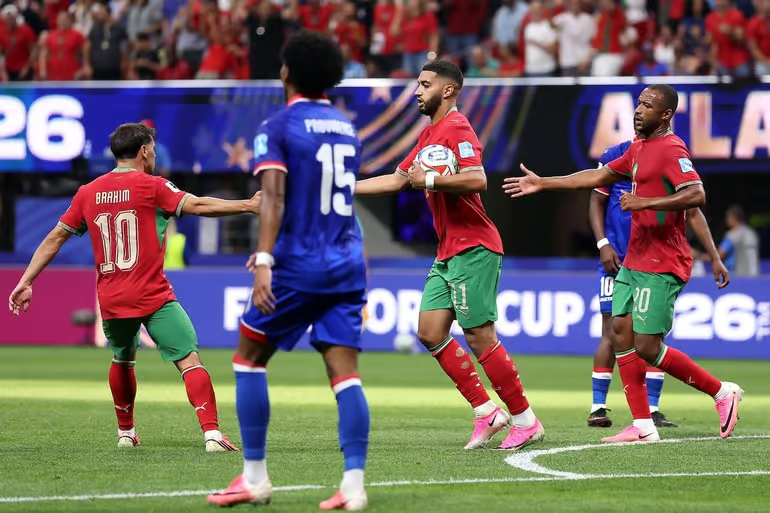
In one of the most dramatic group-stage matches of the 2026 FIFA World Cup, Haiti delivered a jaw-dropping performance against Morocco at Mercedes-Benz Stadium in Atlanta on Wednesday, June 24, holding the highly fancied Atlas Lions to a pulsating 2-2 draw at halftime in a match packed with world-class goals, momentum swings, and a historic moment for Caribbean football. With the score tied at 2-2 heading into the second half, all eyes remained on Atlanta as Morocco pushed hard to secure top spot in Group C, while Les Grenadiers played with nothing but pride, determination, and a nation’s hopes on their shoulders.
Match Summary: A First Half to Remember
The Group C finale at Mercedes-Benz Stadium was supposed to be a routine exercise for Morocco, but Haiti had entirely different ideas. The Haitian side, already eliminated from the tournament and playing for pride alone, stunned the 68,000-strong crowd inside the Atlanta venue with an early opener that silenced Morocco’s formidable fanbase.
The first 45 minutes delivered four goals, relentless end-to-end action, and a performance from the Haitian national team that will be talked about long after the 2026 World Cup has concluded. Here is how the goals fell:
Goal-by-Goal Breakdown (First Half)
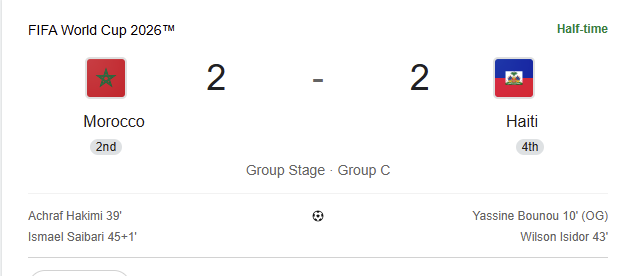
10′ – Lenny Joseph (Haiti): Playing in what is only their second-ever World Cup, Haiti struck first through Lenny Joseph, who converted a precise assist from Jean-Kevin Duverne with a composed finish inside the box. It was Haiti’s first goal of the 2026 tournament and a moment that sent the Haitian diaspora into raptures across the world. Morocco’s goalkeeper Yassine Bounou could do nothing to stop it.
39′ – Achraf Hakimi (Morocco): Morocco’s captain and one of world football’s finest right-backs, Achraf Hakimi, equalised in the 39th minute. Bursting forward in trademark fashion, Hakimi was in the right place at the right time to bundle the ball home from close range after a deflected cross found its way onto the goal line. Morocco 1-1 Haiti.
43′ – Wilson Isidor (Haiti): Just four minutes after Morocco levelled, Haiti reclaimed the lead in stunning fashion. Wilson Isidor unleashed an absolute thunderbolt from distance that rocketed into the top left corner of the net, leaving Bounou with no chance whatsoever. A brilliant individual strike that sent shockwaves through the stadium.
45+1′ – Ismael Saibari (Morocco): In the first minute of first-half stoppage time, Morocco struck back yet again. Ismael Saibari, Morocco’s standout attacker and the nation’s most dangerous player in the tournament, fired a right-footed shot from the centre of the box with an assist from Hakimi to level the game at 2-2 heading into the break.
Lenny Joseph: The Man Who Gave Haiti a World Cup Dream
If there is one name that has been on the lips of football fans around the world today, it is Lenny Joseph. The Haitian forward scored his country’s first goal of the 2026 FIFA World Cup against Morocco, etching his name into the history books. His calm, assured finish from Jean-Kevin Duverne’s assist in just the 10th minute gave Haiti a lead that nobody in the football world had predicted.
Joseph’s goal sparked wild scenes of celebration among Haitian supporters inside Atlanta Stadium, and across Port-au-Prince and the wider Haitian diaspora spread across France, the United States, and Canada. For a nation that had not appeared at a men’s World Cup since 1974, this was a moment of monumental proportions.
Haiti’s Historic World Cup Return: 52 Years in the Making
The 2026 FIFA World Cup marks only the second time in history that the Haiti national football team, known as Les Grenadiers, has competed at football’s biggest stage. Their first and only previous appearance was at the 1974 World Cup in West Germany, where they were drawn into a brutal group alongside Italy, Poland, and Argentina, conceding 14 goals across three matches. The 52-year gap between their first appearance in 1974 and their return in 2026 is one of the longest in World Cup history, behind only Wales (64 years), Egypt (56 years), and Norway (56 years).
Haiti secured their place at the 2026 tournament by finishing first in Group C during the third round of CONCACAF qualifying, defeating Nicaragua 2-0 on the final matchday to confirm their historic return. Head coach Sebastien Migne, the French tactician appointed in March 2024, oversaw the entire qualifying campaign that saw Haiti overcome Costa Rica and Honduras to claim top spot.
What makes this Haitian squad particularly remarkable is the story it tells about global migration and the Haitian diaspora. Of the 26 players selected for the 2026 World Cup, only 10 were born in Haiti itself, with 12 born in France of Haitian parentage. The squad is both a symbol of national pride and a vivid reflection of the Haitian experience across the world.
Morocco’s 2026 World Cup Campaign: Atlas Lions Eye Knockout Glory
For Morocco, the 2026 FIFA World Cup represents the continuation of a golden era in African football. The Atlas Lions entered the Atlanta match with four points from two games, tied at the top of Group C with powerhouses Brazil. Their campaign began with a hard-fought 1-1 draw against the five-time world champions, followed by a confident 1-0 victory over Scotland, with both goals in the tournament coming from the impressive Ismael Saibari.
The 2026 World Cup is Morocco’s seventh appearance at the global tournament, following previous showings in 1970, 1986, 1994, 1998, 2018, and most memorably the 2022 Qatar World Cup, where they became the first African nation to reach the semi-finals. Building on that historic run, Morocco arrived in the United States with legitimate ambitions of going deep into the knockout rounds once again.
Captain Achraf Hakimi remains the heartbeat of this Moroccan side, providing energy, creativity, and goals from right back. Alongside him, Yassine Bounou in goal, Brahim Diaz in midfield, and the clinical Ayoub El Kaabi lead a squad that combines European club-level pedigree with genuine international ambition. Manager Mohamed Ouahbi has built a cohesive unit that blends defensive solidity with attacking threat.
Group C Standings and What Is at Stake
Heading into Matchday 3, the Group C standings were exceptionally tight at the top. Brazil and Morocco were level on four points each, with Scotland sitting in third on three points and Haiti rooted to the bottom with zero points following defeats to Scotland and Brazil. With all four sides playing simultaneously on June 24, the final group positions were still very much up for grabs.
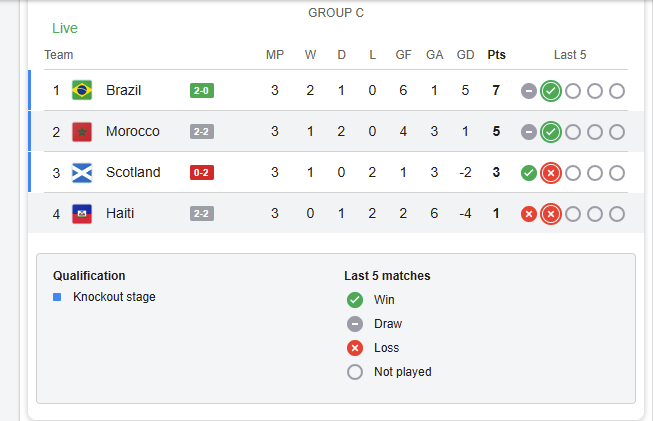
For Morocco to claim top spot in Group C, they needed to beat Haiti and simultaneously hope that Scotland held Brazil in Miami. A draw was always enough to secure qualification, even if it handed Brazil the group lead on goal difference. For Haiti, the mathematics of qualification had long been resolved, but a draw against Morocco would represent a landmark result, potentially the first point ever taken by Haiti at a men’s World Cup finals.
Meanwhile, in the parallel fixture in Miami, Brazil were taking on Scotland, with the Scots needing a result to secure their own knockout berth. Brazil led Scotland 2-0 at halftime, making the final group standings increasingly clear: Brazil were heading toward first place, with Morocco set to advance as group runners-up.
Key Players to Watch in the Second Half
Achraf Hakimi (Morocco) – The Paris Saint-Germain fullback and Morocco captain has been one of the standout performers in Group C. His goal against Haiti added to his growing reputation as one of the world’s most complete defenders, equally dangerous in attack.
Ismael Saibari (Morocco) – The Dutch-born Moroccan midfielder has been his country’s most consistent attacking threat, scoring in every group game. His 45+1 equaliser against Haiti showcased his poaching instincts and composure under pressure.
Wilson Isidor (Haiti) – The striker’s thunderous long-range effort in the 43rd minute was one of the goals of the tournament so far. Isidor brought power, pace, and an eye for goal that Morocco simply could not contain for large stretches of the opening half.
Johny Placide (Haiti) – The veteran Haitian captain and goalkeeper has been a commanding presence throughout the tournament, making crucial saves at key moments against both Brazil and Morocco. His leadership on and off the pitch has defined Haiti’s performances at this World Cup.
Lenny Joseph (Haiti) – The man of the moment. Joseph’s first-half opener gave Haiti a stunning lead and demonstrated the quality that this Haitian generation possesses. His calm, precise finish belied the enormous pressure of the occasion.
Morocco’s Road Ahead in the 2026 World Cup
Regardless of the second-half outcome against Haiti, Morocco’s passage into the Round of 32 was effectively secured well before kickoff. The question for the Atlas Lions was always about positioning. As group runners-up, Morocco would likely face the winners of Group F in the knockout rounds, with Netherlands leading that group ahead of Japan at the time of writing.
Morocco will be optimistic about their chances in the knockout rounds. Their defensive record has been exceptional throughout the tournament, and the attacking threat posed by Hakimi, Saibari, Brahim Diaz, and El Kaabi gives them multiple avenues to hurt any opposition. For a squad that reached the semi-finals in 2022, the ambition this time around is nothing less than repeating, or surpassing, that historic achievement.
Haiti Leaves a Legacy Beyond Results
While Haiti exits the 2026 World Cup group stage without a victory, the story of Les Grenadiers is far bigger than points tallies and goal differences. Their return to the World Cup stage after 52 years has been one of the most emotionally resonant narratives of the entire tournament. From their competitive opening against Scotland to their stunning first-half display against Morocco, Haiti has shown the world that Caribbean football is very much alive.
The diaspora dimension of this Haitian squad, with players drawn from France, the United States, Canada, and Haiti itself, underscores the global reach of Haitian culture and the enduring power of football as a vehicle for national identity. Duckens Nazon, Haiti’s all-time leading scorer who drove their qualification campaign with six goals, Johny Placide’s experienced captaincy, and the emergence of young talents like Carl Sainte, all point toward a brighter future for Haitian football.
Their performance against Morocco today, regardless of the final result, will inspire the next generation of Haitian players and fans. In a country that has faced extraordinary hardship in recent years, the sight of Les Grenadiers competing on the biggest football stage in the world carries a meaning that transcends sport entirely.