
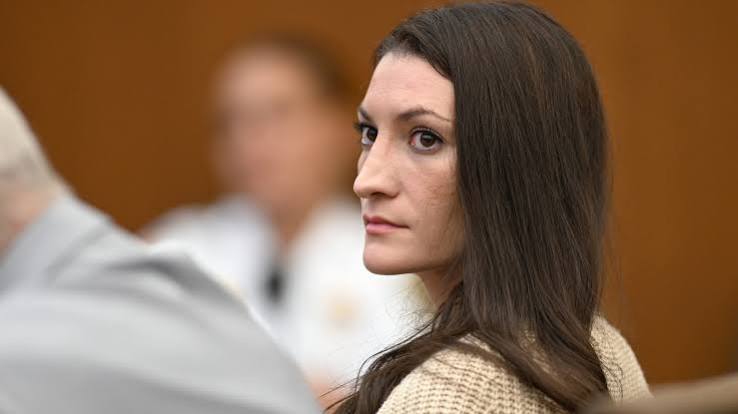
PLYMOUTH, Mass. — A Massachusetts jury began deliberating Thursday in the murder trial of Lindsay Clancy, the Duxbury mother accused of strangling her three young children in January 2023, after prosecutors and defense attorneys delivered closing arguments that centered on whether she was criminally responsible for the killings.
No verdict had been reached as of Thursday afternoon. The 12 jurors, nine women and three men, must now weigh competing accounts of Clancy’s mental state at the time of the deaths and decide among several possible outcomes, ranging from acquittal to convictions on first-degree murder.
What happened in court
Closing arguments in the case, formally Day 22 of the trial, ran for nearly two hours at Plymouth Superior Court before Judge William Sullivan sent the case to the jury. Clancy, 36, a former labor and delivery nurse, has pleaded not guilty to three counts of first-degree murder in the deaths of her children Cora, 5, Dawson, 3, and Callan, 8 months, at the family’s Duxbury home on January 24, 2023.
Both the prosecution and the defense agree that Clancy caused her children’s deaths. The trial has instead turned on the question of her mental state and whether she should be held criminally responsible. Clancy did not testify during the proceedings.
Sullivan reviewed the verdict slips with jurors before they left the courtroom. For each of the three children, jurors must choose among five options: not guilty, not guilty by reason of lack of criminal responsibility, guilty of first-degree murder, guilty of second-degree murder, or guilty of manslaughter. The judge reminded jurors that Clancy retains the presumption of innocence unless they conclude, to a standard of proof beyond a reasonable doubt, that the charges are true.
“Proof beyond a reasonable doubt does not mean proof beyond all possible doubt, for everything in the lives of human beings is open to some possible or imaginary doubt,” Sullivan told the panel, according to a pool video feed of the proceedings. He added that jurors should judge the case solely on the evidence presented and resist reaching conclusions based on outside opinions or bias.
The prosecution’s argument
Assistant District Attorney Jennifer Sprague delivered the closing argument for the prosecution, telling jurors that Clancy was a “functioning mom” who understood the difference between right and wrong when she killed her children. Sprague argued that the degree of planning involved in the killings undercuts the defense’s claim that Clancy was in the grip of psychosis.
Sprague also pointed to Clancy’s professional background as a labor and delivery nurse, arguing she understood the importance of following medical instructions and providing accurate information to her health care providers. Prosecutors have said that Clancy moved between multiple providers and did not fully disclose her symptoms because she wanted to manage her recovery “on her own terms,” according to Sprague’s closing.
The prosecution’s case rests on the theory that Clancy acted with deliberate premeditation and extreme atrocity or cruelty, the legal standard required for a first-degree murder conviction on that theory. In her closing, Sprague described the scene in the home in graphic terms, telling jurors that Clancy left her children’s bodies as though they had been discarded, and argued the evidence showed her guilt to “a moral certainty.”
The defense’s argument
Defense attorney Kevin Reddington, known for an unscripted, combative courtroom style, told jurors that his client should not be held criminally responsible because she was in the grip of postpartum psychosis, a severe and comparatively rare mental health condition that can produce delusions and hallucinations. Reddington argued Clancy heard a hallucinated male voice that she believed was compelling her to act.
Reddington described Clancy as “a darn good mother,” telling the jury she had been a nurse, a daughter and a wife who “did nothing wrong in her life.” He argued the killings were the result of “the damn medicine and the lousy medical care” Clancy received in the weeks before the deaths, saying she had been prescribed a heavy combination of psychiatric medications that worsened rather than treated her condition.
The defense leaned heavily on the testimony of forensic psychiatrist Dr. Phillip Resnick, who evaluated Clancy and testified that she was “frankly psychotic” and not in control of her actions at the time of the killings. Reddington also criticized the American psychiatric profession’s standard timeframe for diagnosing postpartum-onset mental illness, arguing that a narrower cutoff used by U.S. clinicians does not reflect the reality that postpartum psychiatric conditions can emerge months after childbirth.
Reddington used part of his closing to attack the credibility of the prosecution’s rebuttal witnesses and to argue that prosecutors had mischaracterized statements made by his own medical experts during the trial. After jurors were dismissed to begin deliberating, Reddington filed a motion for a required finding of not guilty. The prosecution opposed the motion, and the judge denied it.
Jury deliberations and trial status
As of Thursday afternoon, the jury had not reached a verdict, and no timeline for a decision had been publicly confirmed by the court. The panel was seated this week after 18 jurors, 12 women and six men, sat through the full trial without knowing until Thursday which of them would serve as the final 12 deliberating jurors and which would be dismissed as alternates. Court officials selected the final panel by randomly drawing names.
If convicted of first-degree murder, Clancy faces a mandatory sentence of life in prison without the possibility of parole. A conviction on the lesser charges of second-degree murder or manslaughter would carry different sentencing exposure under Massachusetts law. If the jury finds Clancy not criminally responsible for the killings, she would be committed to a state psychiatric facility rather than sentenced to prison. A straight not-guilty verdict is also among the options available to jurors on each of the three verdict slips.
Key context
Clancy called 911 in the hours after the killings and later attempted to take her own life by jumping from a window at the family’s home, according to earlier reporting on the case. She survived and has used a wheelchair during court appearances since. Her former husband, Patrick Clancy, has said publicly that he does not blame his estranged wife for the deaths of their children, describing her as someone who “got sick” rather than as someone who intended harm.
The case has drawn sustained national attention over its five-week run, with the trial becoming a flashpoint in broader public discussion of gaps in maternal mental health care in the United States. Supporters of Clancy have packed the courtroom gallery throughout the proceedings, with overflow crowds gathering outside the Plymouth courthouse during closing arguments on Thursday.
Earlier in the trial, Judge Sullivan denied a defense motion for a mistrial after a witness referenced Clancy’s Catholic upbringing during testimony, an issue the defense argued had been improperly raised twice during the proceedings. The judge instructed jurors to disregard the reference rather than declaring a mistrial.
What happens next
The jury will continue deliberating until it reaches a unanimous decision on each of the three verdict slips or the court determines that further deliberation would not be productive. No additional testimony or argument is expected before a verdict is returned. GlobalDesk.news will provide updates as the jury’s deliberations continue and when a verdict is announced.
If you or someone you know is experiencing thoughts of suicide, the 988 Suicide and Crisis Lifeline is available by call or text, or online at 988lifeline.org.