
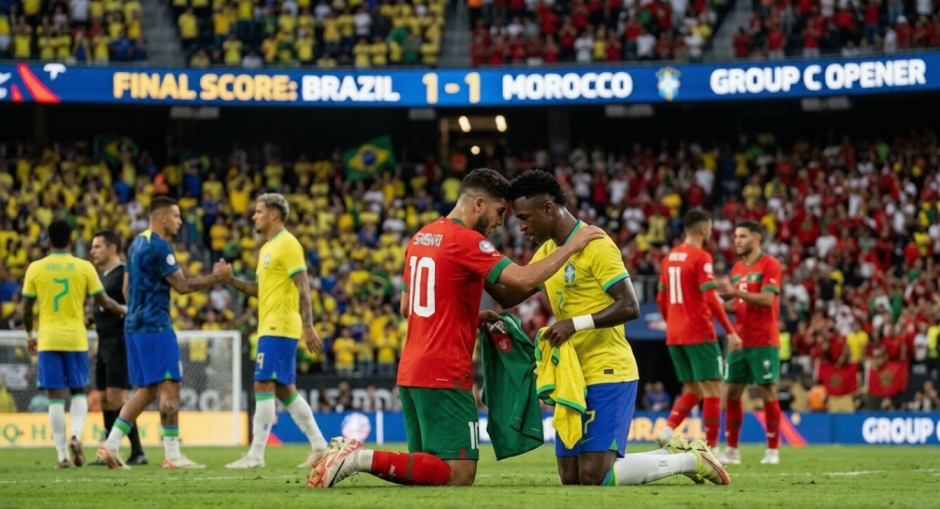
Atlas Lions Hold Five-Time Champions to Stunning 1-1 Draw in New Jersey as Saibari’s Chip Sets the Tone for a Ferocious Group C
There are matches that live up to their billing, and then there are matches that surpass it entirely. Saturday evening at MetLife Stadium was very much the latter.
In front of 80,663 spectators crammed into one of the loudest arenas this World Cup will stage, Brazil and Morocco traded goals, blows, and tactical bluffs in a Group C opening fixture that sent a clear message to every team left in the tournament: neither side came here simply to participate.
The final scoreline — 1-1 — will read like a fair result on paper. But that flat arithmetic cannot capture the drama that crackled through New Jersey from the first whistle. Morocco, under their new coach Mohamed Ouahbi, who took charge just three months before the tournament, arrived not as cautious underdogs but as a team convinced of their own authority. And for large stretches of a compelling evening, they justified every ounce of that confidence.
Brazil, meanwhile, a side that had not won a World Cup since 2002 and that arrived in North America under the command of Carlo Ancelotti, were given an uncomfortable reminder that their star-powered squad still has edges to smooth out. The Seleção were second-best for the first quarter-hour, stunned by a Moroccan opener of real quality, and only rescued by a moment of individual brilliance from the one player on the pitch who can manufacture magic from nothing.
Morocco Strike First: Saibari’s Class Silences the Faithful
Morocco’s dominance in the early stages was no accident. Their midfield three of Ayyoub Bouaddi, Neil El Aynaoui, and Azzedine Ounahi pressed with a relentless intensity that disrupted Brazil’s rhythm before it could be established. The Atlas Lions were quick out of their press, compact in their shape, and sharp in their transitions — a blueprint that has become the hallmark of this Moroccan generation.
The opening goal, when it arrived in the 21st minute, was a thing of elegance. Brahim Diaz, pulling the strings in the attacking third, threaded a perfectly weighted through ball into the channel. Ismael Saibari collected without breaking stride, drew Alisson off his line, and produced a delicate, perfectly measured chip that floated over the Brazilian goalkeeper and nestled into the net. It was the kind of finish that requires composure bordering on arrogance — the sort of goal that signals to your opponents that this is not a team that came to sit back.
The MetLife crowd was briefly silenced. Brazil’s defensive structure, with Roger Ibanez and Marquinhos as the central pair, had been exposed by a straight-line run and a single pass. The questions that have occasionally followed this Brazil side — about their defensive stability, about what a post-Neymar attack looks like under pressure — suddenly felt very current.
Vinicius Junior: A 50th Cap to Remember
Brazil’s response said everything about the character Ancelotti has been building into this squad. Within eleven minutes of falling behind, they were level — and the man who restored parity did so in a fashion that felt inevitable the moment he collected the ball.
Vinicius Junior, receiving a precise pass from Newcastle midfielder Bruno Guimaraes deep on the left flank, drove into the box, shifted decisively onto his right foot, and curled a shot into the far corner with enough pace to beat Yassine Bounou cleanly. The Real Madrid forward was marking his 50th appearance for the senior national team. He chose the occasion well. It was his 10th international goal, and arguably the most important setting in which he has scored one.
What made the strike particularly notable was not simply the technique — it was the read. Vinicius identified the moment, demanded the ball, and made the decision within a fraction of a second. As former England striker Alan Shearer observed on BBC Sport commentary during the match, the challenge with Vinicius is not a lack of awareness about what he intends to do — it is the near-impossibility of stopping him once he has decided. Cutting back onto the right foot from that left channel is his signature. Morocco’s defence knew it. They still could not stop it.
The first half closed level, with Brazil having generated slightly more possession at 54 per cent, but Morocco leading on expected goals — 1.22 to 0.85 — a statistical illustration of how effectively the Atlas Lions had threatened with fewer touches in advanced areas.
Tactical Chess: A Second Half of Controlled Tension
The interval brought changes from Ancelotti. Both Casemiro and Roger Ibanez had collected yellow cards in the first half, and the Italian manager acted decisively, withdrawing both to protect them ahead of Brazil’s remaining group fixtures against Haiti and Scotland. Fabinho came in for Casemiro, and Danilo replaced Ibanez along the backline.
The substitutions restored some defensive discipline to Brazil’s shape, and the Seleção were noticeably sharper as the second half began. Lucas Paqueta went closest to breaking the deadlock when he produced a spinning volley that Bounou pushed away brilliantly — a save that preserved Morocco’s share of the spoils and demonstrated why the Sevilla goalkeeper remains one of the finest shot-stoppers in international football.
Morocco, for their part, did not simply retreat. Saibari and Diaz continued to probe, winning fouls and unsettling the Brazilian press. Achraf Hakimi burst forward on one counter-attack but dragged his effort just wide of Alisson’s left post — a moment that, had it gone in, would have produced a result as dramatic as any in this tournament’s early days.
In the final twenty minutes, heat — a consistent talking point throughout the evening — appeared to exact its toll. Both teams slowed slightly, chances became harder to manufacture, and the game settled into a pattern of controlled attrition rather than the earlier urgency. Raphinha worked hard on the right side, testing Bounou once from close range, while Brazil’s substitutes injected fresh legs without fundamentally altering the attacking equation.
The full-time whistle confirmed what the scoreboard had been telling both dugouts for over an hour: on this night, neither team was quite ready to make the decisive move.
Match Highlights
- 21′ — MOROCCO GOAL: Brahim Diaz plays Ismael Saibari in behind the Brazil defence; Saibari chips Alisson with a composure and precision that stuns MetLife Stadium. Morocco 1-0 Brazil.
- 32′ — BRAZIL GOAL: Bruno Guimaraes picks out Vinicius Junior on the left; the winger cuts inside, shifts to his right, and curls into the far corner on his 50th international appearance. 1-1.
- 45+2′ — PAQUETA DENIED: Lucas Paqueta’s agile volley inside the box forces Bounou into a spectacular stretching save. Marquinhos’ header from the resulting corner goes begging.
- HT Substitutions: Ancelotti replaces Casemiro (yellow card) with Fabinho and Ibanez (yellow card) with Danilo.
- 52′ — BOUNOU SAVES: Rapid Brazil play down the right ends with a Raphinha cross and a close-range stop from the Moroccan goalkeeper.
- 62′ — HAKIMI WIDE: Morocco’s counter-attack ends with Hakimi dragging just wide of Alisson’s post — a moment that nearly rewrote the story.
- FT: Brazil 1-1 Morocco.
Key Takeaways
Morocco proved they belong at the top table. This was not a Morocco side playing for a point and a clean sheet. They outplayed Brazil for stretches, scored a goal of genuine quality, and created the better chances across ninety minutes. Ouahbi’s appointment, made in crisis just months ago, looks less controversial with each passing fixture.
Brazil were not at their best — and still earned a point. The Seleção were slow to establish themselves, leaky defensively in the opening quarter-hour, and dependent on one player’s genius to stay in the game. That is not a sustainable formula across a tournament. Ancelotti will demand more collective cohesion.
Vinicius Junior is the difference. When Brazil needed something that no tactical instruction can manufacture, their number seven delivered. His value to this team is not merely about goals — it is about the fear he creates in opponents and the confidence he restores in teammates. On a night when Brazil were second-best, he made them equal.
Bounou was magnificent. The Moroccan goalkeeper made several telling contributions, most notably the save from Paqueta’s volley that preserved the draw at a critical juncture. He is in form, and Brazil’s attackers will know it.
What This Means for Group C
The draw shifts the dynamic in Group C considerably. Both Brazil and Morocco now sit on one point each, with Scotland and Haiti — who also played on Saturday — sitting beneath them depending on their own opening result.
For Morocco, a point against one of the tournament’s pre-competition favourites is not a disaster. But their remaining schedule — facing Scotland and then looking ahead — gives them a genuine pathway to advance from the group, and potentially at the top of it. This Moroccan team has the quality and the tactical identity to make that happen.
For Brazil, the concern is less about the point and more about the performance. Ancelotti has a roster full of technical quality — Raphinha, Guimaraes, Endrick on the bench, Paqueta orchestrating — but the defensive cohesion needs attention. Giving a team of Morocco’s quality 1.22 expected goals in an opening group match is a problem that does not go away on its own.
Both teams will know that the remaining fixtures in Group C are winnable. Whether that chance becomes a reality will depend on how quickly each side can learn from what Saturday revealed.
Expert Analysis
What Saturday’s match confirmed is that this Moroccan generation has evolved beyond the emotional heroics of Qatar 2022. The semifinal run in that tournament was extraordinary, historic, even, as the first African and Arab nation to reach that stage. But there was always a question of whether it could be sustained, whether it was a peak that could not be revisited.
The answer, at least through 90 minutes at MetLife Stadium, is that Morocco under Ouahbi are a different kind of team from the one Walid Regragui built before him — but not necessarily a lesser one. The pressing intensity, the controlled counter-attacking, the technical quality in midfield from Saibari and Ounahi — these are the hallmarks of a side with a genuine tactical identity, not a team relying on one good run.
For Brazil, the real test of Ancelotti’s management will come in the next two matches. The veteran Italian manager — the only coach to have won the UEFA Champions League five times — has spent his career finding solutions to tactical problems. His at-halftime decision to withdraw both yellow-carded starters was exactly the kind of pragmatic call that separates tournament managers from those who simply hope their quality wins through.
The question is whether Brazil’s quality can be channelled into something more coherent — more collective — before the knockout rounds demand it.
The 2026 World Cup has its first major talking point. Brazil and Morocco, two of the most closely watched teams in this tournament, played 90 minutes that neither side will easily forget — and left New Jersey with a point apiece and a set of unanswered questions that will define their paths through the group stage.
Vinicius Junior showed, in a single curling finish, why he remains among the most dangerous attacking players on the planet. Ismael Saibari showed, in a single composed chip, that Morocco’s quality runs deeper than their famous names. And the result showed, more than anything, that Group C is going to be fought for every step of the way.
Both teams know what they need to do. Both teams, after Saturday, also know it will not be straightforward.