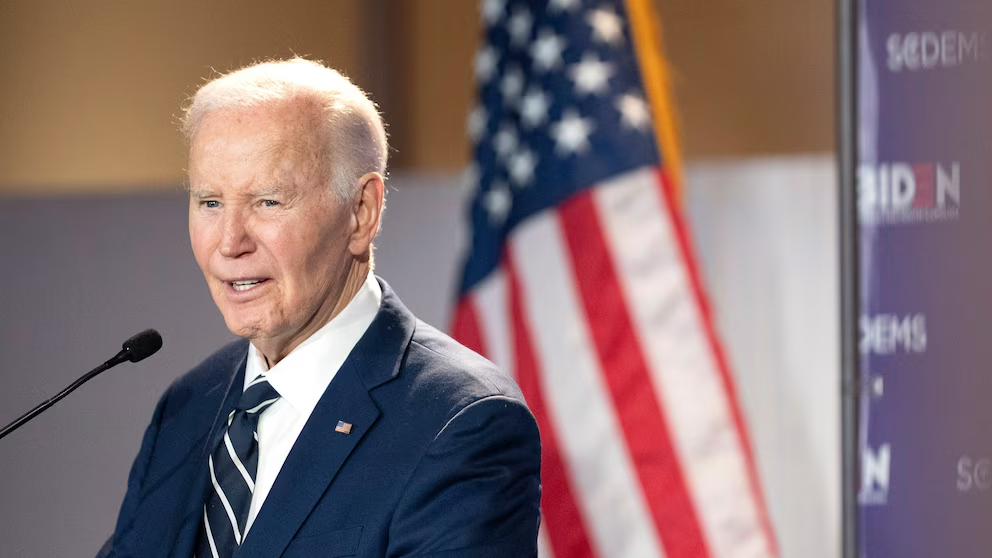
A 26-page ruling by U.S. District Judge Dabney Friedrich finds the public interest in understanding prosecutors’ decision not to charge Biden outweighs his privacy claims, but a three-week hold preserves his right to appeal.
WASHINGTON — A federal judge on Friday denied former President Joe Biden’s bid to block the Justice Department from releasing approximately 70 hours of audio recordings he made with his ghostwriter to a conservative think tank, dealing a significant legal blow to his effort to keep the private conversations out of public view.
U.S. District Judge Dabney Friedrich found that the public interest in the material outweighed whatever privacy rights Biden had, but she effectively put her ruling on hold for up to three weeks so Biden could appeal. ClickOnDetroit
The recordings — made during private sessions between Biden and writer Mark Zwonitzer as the two worked on Biden’s 2017 memoir Promise Me, Dad — were swept up by federal investigators as part of special counsel Robert Hur’s probe into whether the former president mishandled classified documents.
Background: From Special Counsel Probe to FOIA Battle
The audio recordings and transcripts stem from interviews Biden conducted with ghostwriter Mark Zwonitzer for his 2017 memoir. The materials were obtained by the DOJ as part of the special counsel’s probe, which ended in February 2024, finding that Biden “willfully retained and disclosed” classified materials but recommending no criminal charges. ABC News
The Heritage Foundation initially filed a Freedom of Information Act request in April 2024 to obtain the conversations after the DOJ declined to press charges against the former president. Washington Examiner
Under the Biden administration, the Justice Department resisted disclosure, citing FOIA privacy exemptions to shield the recordings and most of the written transcripts from public release. That position reversed sharply after the presidential transition.
While the Justice Department initially withheld the audio tapes and most of the written transcripts, citing certain FOIA exemptions, the department under President Trump said it intended to disclose the material to Congress and the Heritage Foundation. CBS News
Former President Joe Biden sued the Justice Department in May, seeking to block the Trump administration from releasing the recordings and transcripts of his private interviews with the ghostwriter who was helping to write his memoir. The Washington Post.
What the Judge Found
In a 26-page decision issued Friday, Judge Friedrich sided squarely with the Heritage Foundation and the Justice Department on the core legal question: whether the public’s right to understand a major federal investigation superseded Biden’s privacy interest in the conversations.
Friedrich noted that the recorded conversations were significantly redacted and “contain no information about Biden’s family or other private persons.” Her ruling gives the DOJ the green light to release the recordings, though Biden’s lawyers immediately launched an injunction pending appeal. Washington Examiner
The judge quoted FOIA’s foundational purpose in her ruling. “The harm to Biden’s diminished privacy interest is outweighed by the public’s interest in the Zwonitzer materials and FOIA’s ‘policy of broad disclosure of Government documents in order to ensure an informed citizenry, vital to the functioning of a democratic society,'” Friedrich wrote. Washington Examiner
Friedrich wrote that the case involved “an unusually strong public interest in the release” of government records. Union-Bulletin
Friedrich also wrote that Biden failed to prove at this stage that the Justice Department’s decision to release the materials was an abuse of officials’ discretion in weighing his privacy against the public’s interest in the contents. Certain portions would be redacted, the judge said, such as information about Biden’s family and health issues. Union-Bulletin
Biden had objected to the release on personal grounds. Biden objected to the release as an invasion of privacy, saying the recordings included him discussing sensitive personal matters such as the death of his older son, Beau Biden. But Friedrich found that the administration redacted that material. WFMZ.com
Congressional Pressure and the Road to Disclosure
The legal battle over the recordings did not begin in 2026. Congressional Republicans had been pushing for the materials for years. The House Judiciary Committee previously held then-Attorney General Merrick Garland in contempt of Congress after the Biden-era DOJ refused to produce audio from Hur’s separate interview with Biden himself.
During the 118th Congress, the committee conducted oversight of Special Counsel Robert K. Hur’s investigation of President Joe Biden’s willful mishandling of classified information, and requested that Mark Zwonitzer produce the audio recordings of his conversations with President Biden relating to his ghostwriting work. house
The Trump-era DOJ’s reversal on the release policy came after a formal request from congressional Republicans. The Heritage Foundation and congressional Republicans have been trying to get the recordings and unredacted interview transcripts following a 2024 report that cited them as proof of Biden’s “diminished” mental state. Union-Bulletin
A separate legal front also remains open. Separate from the case before Friedrich, Biden filed a lawsuit in May seeking to block the Justice Department from giving the materials to the Republican-controlled House Judiciary Committee. The judge presiding over the committee’s case hasn’t ruled yet on Biden’s request to immediately stop that disclosure. Union-Bulletin
What Happens Next
Friday’s ruling does not mean the recordings will be released immediately. On the heels of Friedrich’s decision, Biden’s lawyers filed an emergency motion asking the judge to block the disclosure of the transcript and tapes to the Heritage Foundation while it appeals her decision — a motion Friedrich later granted. CBS News
Biden’s legal team argued, in their emergency filing, that “This Court should grant an injunction pending appeal to prevent an irreversible change in the status quo.” CBS News
Biden’s attorneys could file an emergency administrative stay to freeze Judge Friedrich’s order. If granted, the stay would block the DOJ from transferring any files while the appellate court reviews the broader merits of the privacy arguments. If the D.C. Circuit declines to intervene, it could create a fast-moving precedent regarding how private conversations swept up in federal investigations are handled under FOIA. For now, the timing remains fluid. Yahoo!
The court found that the former president was unlikely to win on his claim that the disclosure violated the Administrative Procedure Act. TownHall
Legal and Political Implications
Friday’s ruling carries significant implications that stretch well beyond Biden personally. The case tests the boundaries of FOIA privacy protections when private conversations — recorded not for government purposes but for a commercial memoir — become ensnared in a federal criminal investigation.
Friedrich ruled the public has a right to see key evidence behind the Department of Justice’s decision not to charge Biden, even though it includes private conversations with his ghostwriter, because it is central to understanding how prosecutors handled a major investigation. Newsweek
For Biden, the personal stakes are also high. The conversations, around 70 hours of audio recordings, relate to Biden’s 2017 memoir Promise Me, Dad: A Year of Hope, Hardship and Purpose, which was ghostwritten by Mark Zwonitzer. Biden was accused of spilling classified information to Zwonitzer in the ghostwritten tapes while they worked on the book. Washington Examiner
At the same time, the ruling underscores how drastically the posture of the Justice Department has shifted between administrations — from aggressively shielding the recordings to actively facilitating their disclosure to political adversaries and conservative organizations.
The case is Heritage Foundation v. Department of Justice, pending before the U.S. District Court for the District of Columbia. An appeal before the U.S. Court of Appeals for the D.C. Circuit is expected to be filed imminently.