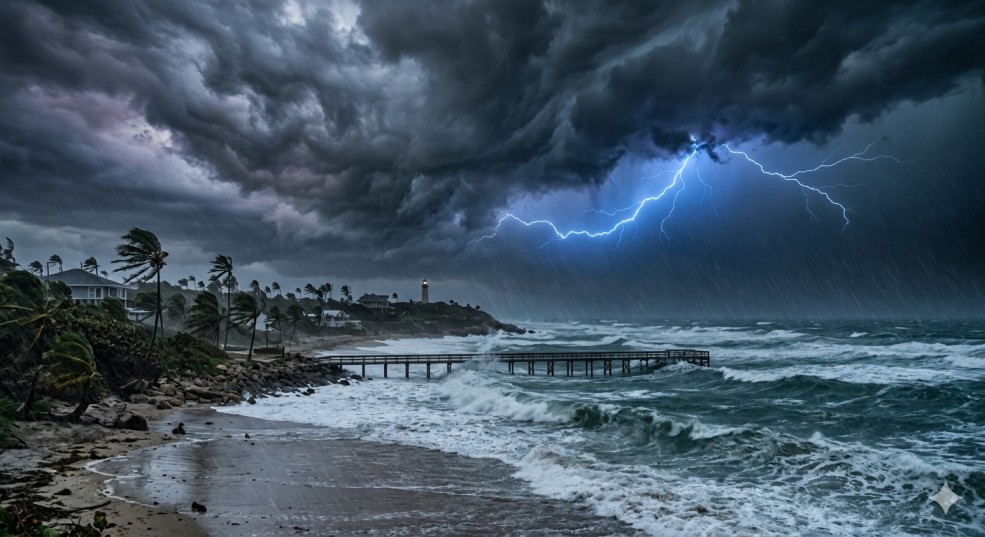
The Gulf Coast is under siege. Tropical Storm Arthur, the first named storm of the 2026 Atlantic hurricane season, has made landfall along the Texas coastline, bringing with it a catastrophic wall of rainfall and a flood threat stretching from Houston all the way to Georgia. Forecasters aren’t mincing words: this system’s most dangerous weapon isn’t wind. It’s water.
The National Hurricane Center confirmed Wednesday that Arthur came ashore packing maximum sustained winds of 45 mph, with a peak gust of 64 mph recorded at a monitoring station in Galveston. While the storm itself ranks as a modest mid-tier tropical system, the relentless moisture it is dragging inland is what has emergency managers on edge across six states.
What We Know Right Now
Arthur earned its name early Wednesday morning after consolidating from what forecasters had been calling Potential Tropical Cyclone One — a disorganized but rain-drenched disturbance that had been crawling along the western Gulf for days. Within hours of formal designation, the storm had scraped onto land near the upper Texas coast.
By Wednesday afternoon, the center of the storm was located roughly 20 miles north-northwest of Matagorda, Texas, tracking northeast at 9 mph. Forecasters say the center will push deeper into extreme southeast Texas before cutting into southwest Louisiana by Wednesday night. It is expected to dissipate into a tropical depression — or dissolve entirely- by early Thursday.
That weakening, however, offers little comfort. The moisture Arthur is carrying will outlast its circulation, continuing to fuel flooding rains across the Southeast well into Friday.
The storm’s origins are notably complex. According to AccuWeather, Arthur drew energy from several converging sources: the remnants of former eastern Pacific Tropical Storm Cristina, a tropical wave from Africa, a stalled weather front, and the jet stream. That convergence created the enormous moisture footprint now spreading across the region.
The Flood Danger: Numbers That Matter
The National Hurricane Center and National Weather Service have been explicit in their warnings: rainfall — not wind — is the primary hazard.
Forecasters project widespread totals of 5 to 10 inches across eastern Texas, southern and central Louisiana, Mississippi, Alabama, and the western Florida Panhandle through early Friday. In the most rain-saturated zones, isolated pockets could absorb up to 20 inches. That kind of accumulation, compressed into 48 to 72 hours, can trigger catastrophic flash flooding even in areas with functioning drainage infrastructure.
Rainfall rates of 2 to 4 inches per hour — or higher — were being observed in some areas Wednesday, making road flooding sudden and unavoidable. Flood watches covered more than 18 million people stretching from eastern Texas to Georgia.
Storm surge is an added complication along the immediate coast. A 2-to-4-foot surge was forecast from Port Bolivar, Texas, to Morgan City, Louisiana, with up to 3 feet possible inside Galveston Bay. Normally dry low-lying areas near shorelines were flooding as the tide and surge combined to push water inland. Swells generated by Arthur are also producing dangerous surf and rip current conditions along the northwestern Gulf Coast.
Scattered tornadoes remain possible through Thursday, particularly across southeast Texas, southern Louisiana, and southern Mississippi.
Regions in the Crosshairs
The threat stretches farther inland than a glance at the Texas coast might suggest.
Texas: Galveston and the upper coast are directly in Arthur’s path. The storm’s center is expected to pass near Houston as it moves inland, with the surrounding counties — Galveston, Harris, Brazoria, Fort Bend, Chambers, and others- all under flood watches. The Houston metro, a region that still carries the memory of Harvey’s devastation in 2017, is bracing for yet another heavy rainfall event on already-saturated ground.
Flooding has been ongoing in Texas for days before Arthur even formed. Austin shattered its single-day rainfall record dating to 1964 earlier this week. Waco saw multiple vehicles stranded on Interstate 35, prompting water rescues. Over 100 low-water crossings in the Austin area were closed. In Freeport, two people were pulled from a vehicle trapped by rising floodwater. The San Jacinto River Authority released water from Lake Conroe as a precaution.
Louisiana: A Tropical Storm Warning remains in effect from High Island, Texas, to Morgan City, Louisiana. New Orleans is on alert — Mayor Helena Moreno held a press conference Wednesday urging residents to treat the storm seriously. Police deployed boats, barricades went up in known flood-prone neighborhoods, and the city opened sandbag distribution sites. Arthur isn’t the catastrophic hurricane that has haunted this region before, officials acknowledged, but the rainfall totals being forecast could still cause significant damage.
Mississippi and Alabama: The highest flash flood potential over the three-day period runs from Lake Charles, Louisiana, to Montgomery, Alabama, with forecasters flagging Mobile as the area expected to receive the heaviest totals. By Thursday evening, Arthur’s remnant moisture band is forecast to stretch from Atlanta to Montgomery to Mobile.
Georgia and the Florida Panhandle: Far-western portions of the Florida Panhandle face impacts through the weekend, and rainfall is expected to reach parts of western Georgia as the system’s moisture continues northeast.
What Officials and Experts Are Saying
Dan Brown, operations chief at the National Hurricane Center, put the situation plainly: “A lot of the winds have already been occurring along portions of the coast of Texas and Louisiana, and there’s also been a lot of heavy rainfall that’s kind of preceded both the development of the storm and the center of the storm.”
That’s a critical point. Arthur has been hitting residents before it was even named. The system’s flooding impact predates its official designation by days — a reminder that tropical systems don’t need to carry a name to cause serious harm.
Zachary Handlos, an atmospheric scientist at the Georgia Institute of Technology, noted a complicating factor for the Southeast: much of the region spent the spring in prolonged drought. Recent rains have softened some of that dryness — but in doing so, may have primed the soil to funnel water more aggressively once it can no longer absorb. “After going through most of March, April and some of May with almost no precipitation, things have kind of switched,” Handlos told NBC News.
NOAA and the National Weather Service have had flood watches and warnings stacked across the region for much of the week. Forecasters have emphasized that residents should not wait to see floodwater before acting. Multiple water rescues across Texas underscore how rapidly conditions can turn fatal.
What Happens Next
Arthur is expected to lose tropical characteristics by Thursday morning as it moves inland away from the Gulf’s warm water. But the system’s moisture will linger.
The heaviest rainfall focus shifts eastward through Thursday and into Friday, targeting the Baton Rouge corridor by early Thursday morning, then moving on toward Mobile and the broader Southeast. Atmospheric scientists are watching how quickly the system’s forward speed increases — a faster storm means rain spreads more widely but at lower totals per location; a slower system concentrates downpours, raising the catastrophic flooding risk in a narrower area.
The 2026 Atlantic hurricane season, which began June 1 and runs through November 30, was forecast to be below average overall, with strengthening El Niño conditions expected to suppress activity later in the season. Arthur’s arrival on approximately June 18 aligns almost precisely with the historical median date for the Atlantic’s first named storm, according to University of Miami hurricane researcher Brian McNoldy.
The National Hurricane Center will continue issuing advisories as long as the system maintains any tropical characteristics. Residents in affected areas should monitor updates from their local National Weather Service offices, and FEMA has resources available for those facing emergency flood situations.
The Next 48 Hours Are Critical
Arthur may be weakening structurally, but its flood threat is very much alive. The combination of a storm-softened landscape, days of pre-existing rainfall, tropical moisture on the scale of a named system, and projected totals that could locally reach 20 inches creates the conditions for life-threatening flash flooding in areas that may not even see a named storm make landfall nearby.
Residents from Houston to Mobile should avoid all unnecessary travel, keep multiple methods of weather alerts active, including wireless emergency alerts on mobile devices, and avoid any low-water crossings, which can become life-threatening within minutes. If water is rising around a vehicle, the guidance from emergency managers is unambiguous: get out and move to higher ground immediately.
The next 48 hours will determine whether Arthur’s passage through the Deep South is remembered as a manageable weather event or a significant regional flooding disaster. Track the latest advisories at the National Hurricane Center and your local National Weather Service. For federal emergency resources, visit FEMA.gov.