LOS ANGELES — As California election workers continue the painstaking process of tabulating over 3.5 million uncounted primary ballots, the state has become the epicenter of a fierce political debate over election integrity, federal oversight, and the sheer mechanics of American democracy.
The slow pace of the vote tally—a routine characteristic of California’s heavily mail-based voting system—has drawn sharp criticism from high-profile political figures and prompted an intervention by federal authorities. However, independent election experts and state officials emphasize that the extended timeline is an indicator of security and accuracy rather than systemic malfeasance.
Federal Prosecutors Step In
The controversy intensified after First Assistant U.S. Attorney Bill Essayli announced via social media that his office, alongside the FBI’s Los Angeles field office, had launched “multiple election fraud investigations” into the state’s voting processes. While Essayli refrained from providing specific details on active investigations, he cited what he termed “serious structural vulnerabilities” within California’s election framework.
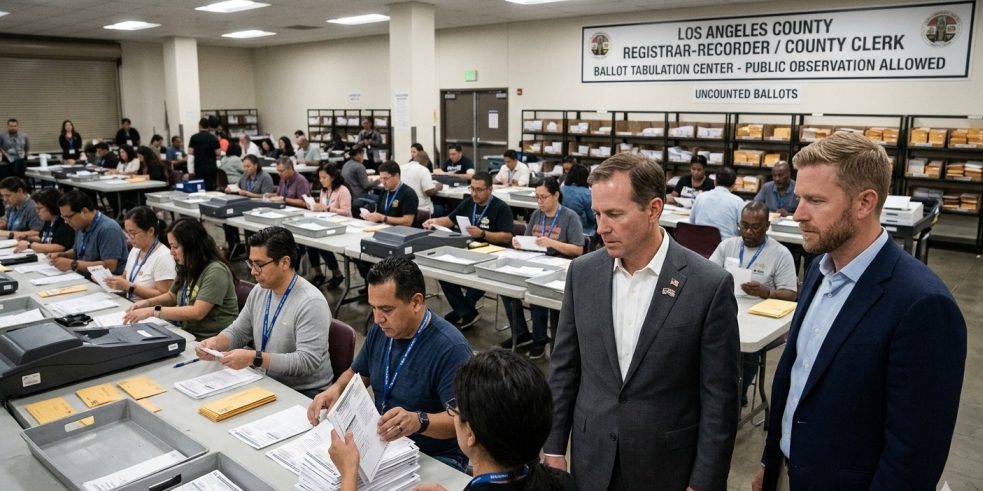
As part of this federal interest, Assistant U.S. Attorney Robert Renner was dispatched to a Los Angeles County ballot processing center to personally observe the ongoing tabulation. The Los Angeles County Registrar-Recorder’s office confirmed the visit, stating that the federal prosecutor was given a routine walkthrough of the facility’s extensive public observation program.
The escalation directly followed remarks made by President Donald Trump. Speaking from the Oval Office, Trump claimed without providing evidence that Democrats were “rigging the election” to deliberately disadvantage his preferred Republican candidates—Steve Hilton for Governor and Spencer Pratt for Mayor of Los Angeles—as later batches of mail-in ballots began to alter early election-night rankings.
Why Does California’s Count Take So Long?
For political observers outside the Golden State, a multi-week counting process can seem alarming. Yet, election lawyers and state historians emphasize that California’s timeline is mandated by laws designed to maximize voter access and rigorous double-checking.
According to the California Secretary of State’s Office, counties have a statutory window of up to 30 days to finalize and certify official election results. Several structural safeguards contribute to this deliberate timeline:
- Permissive Postmark Deadlines: Every eligible registered voter in California (roughly 23 million people) is automatically mailed a ballot. Under state law, any ballot postmarked by Election Day remains completely valid as long as it arrives at a county election office within seven days.
- The “Signature Cure” Process: If a voter forgets to sign their mail-in ballot envelope, or if their signature does not match the digitized exemplar on file, election workers do not simply discard the vote. By law, officials must contact the voter and allow them a 22-day window to verify their identity and “cure” their ballot.
- Late Democratic Surges: Statistically, early returns and in-person votes heavily favor Republican candidates, creating a “red mirage” on election night. Conversely, younger and left-leaning voters historically wait until the last possible minute to drop off or mail their ballots. The massive influx of late-arriving mail ballots routinely causes the margins to shift progressively blue in the days following the election.
Bipartisan Pushback Against Fraud Allegations
Democratic leaders and election administrators have pushed back aggressively against allegations of a “stolen” election. California Secretary of State Shirley Weber issued a public reminder stressing that “accuracy comes before speed.” Weber noted that taking the necessary time to carefully process millions of ballots protects voters’ constitutional rights and preserves the bedrock integrity of the system.
State Assemblymember Marc Berman, who authored recent legislation aimed at optimizing ballot processing pipelines, flatly characterized the fraud allegations as a deliberate lie meant to erode public trust.
Even within the Republican field, responses to the fraud narrative have been mixed. While Republican gubernatorial candidate Steve Hilton acknowledged that the sluggish pace makes the state a “laughingstock” nationally, he openly noted that his own campaign’s internal observers had witnessed absolutely nothing indicative of illegal activity or fraud.
As the June 15 deadline for counties to complete their initial tallies approaches, election experts warn that weaponizing the state’s deliberate bureaucratic processes to spread misinformation poses a significant threat to long-term civic confidence.
For Further Reading and Independent Tracking:
- Monitor live, official status updates on remaining uncounted ballots via the California Secretary of State Election Results Portal.
- Read the comprehensive breakdown of how mail-in ballot laws affect modern political campaigns on PBS NewsHour.
- Review historical legal precedents concerning ballot-curing deadlines at the UCLA School of Law Voting Rights Project.
For more context on how this story broke, you can watch this KTLA 5 News Report on YouTube which outlines the initial announcements made by the U.S. Attorney’s office regarding the deployment of federal observers to California vote-counting centers.